Presentation
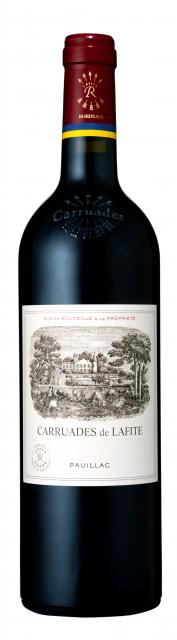
Given the refined selection of fine wines after two decades, the Carruades feature characteristics similar to those of the fine wine, but with their own personality linked to a higher percentage of Merlot in its composition, and plots of land that are clearly identified as producing Carruades. The origin of the name comes from the Carruades plateau, the name of a group of plots adjacent to the chateau’s best vineyards, purchased in 1845 by Château Lafite. In the 20th century, the Carruades were marketed separately from Château Lafite before being integrated. The name Carruades adopted as the name of Château Lafite Rothschild’s second wine, was initially called “Moulin des Carruades” before the 1980’s
The vintage
The very wet, cold winter resulted in work in the vineyard being considerably delayed; bud break was late, and flowering was three weeks later than the average for the last 50 years; the changeable weather resulted in some flower abortion and uneven grape size, and therefore in lower potential yields than usual. Then at the end of June, the weather suddenly changed, and it was if we were in the middle of the summer with no transitional period; there were however several localized storms (on 27 July and 2 August, depending on location).
The situation became somewhat challenging from 15 September: there was rain, sun and a long wait for the grapes to fully ripen, even though they had partially caught up from the late start; things then became more delicate at the end of September, when it became clear there was a risk of "explosive" growth of botrytis! It was like a race with no time to warm up, and we had to find all the pickers we could to go as quickly as possible. Fortunately, the sorting teams were very efficient despite the difficult harvest. The usual picking sequence for the red wine grapes had to be adjusted in order to minimize the impact of the botrytis and to take into account the potential to make the first or second wine.
The situation became somewhat challenging from 15 September: there was rain, sun and a long wait for the grapes to fully ripen, even though they had partially caught up from the late start; things then became more delicate at the end of September, when it became clear there was a risk of "explosive" growth of botrytis! It was like a race with no time to warm up, and we had to find all the pickers we could to go as quickly as possible. Fortunately, the sorting teams were very efficient despite the difficult harvest. The usual picking sequence for the red wine grapes had to be adjusted in order to minimize the impact of the botrytis and to take into account the potential to make the first or second wine.
Varietals
Cabernet sauvignon : 64%
Merlot : 29%
Cabernet franc : 4%
Petit verdot : 3%
Merlot : 29%
Cabernet franc : 4%
Petit verdot : 3%
Tasting
After bottling, the nose is closed, and will require a few months to gain a little more expression. On the palate the fruit is well-expressed and has a roundness that counterbalances the lively finish.